How to Source Custom Umbrellas from China: The 8-Step Insider’s Map (2026)
Decision Summary (Read This First)
Share your target model, quantity, and artwork file—we’ll recommend the best spec and printing method.
Importing custom umbrellas from China can be highly profitable, but the process can feel opaque.
Quality is hard to judge from photos, and logistics can surprise new buyers with extra steps and costs.
In 2026, successful sourcing isn’t about “finding a factory.” It’s about spec precision, QC standards, and logistics control.
Below is the exact workflow we use with global B2B clients—from first sketch to final delivery.
Quick Summary: The Typical Sourcing Timeline
7–12 Days
25–40 Days
Air 5–10 / Ocean 35–60 Days
- Total Lead Time: Plan for 6–12 weeks (air) or 10–16 weeks (ocean), depending on season and destination.
- Key Success Factor: A clear Tech Pack upfront prevents delays, re-sampling, and cost surprises.
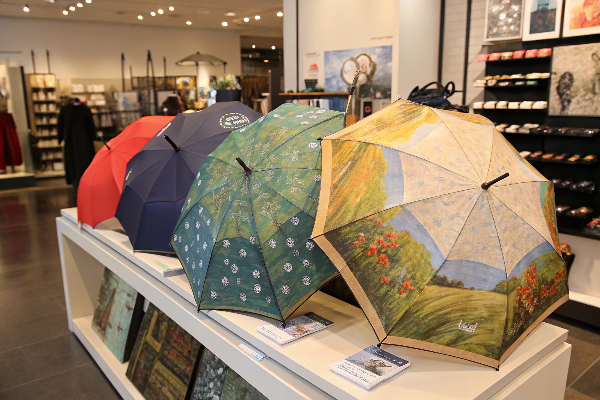
Phase 1: Pre-Production (Spec + Sampling)
Step 1–3: Lock the spec before you talk price
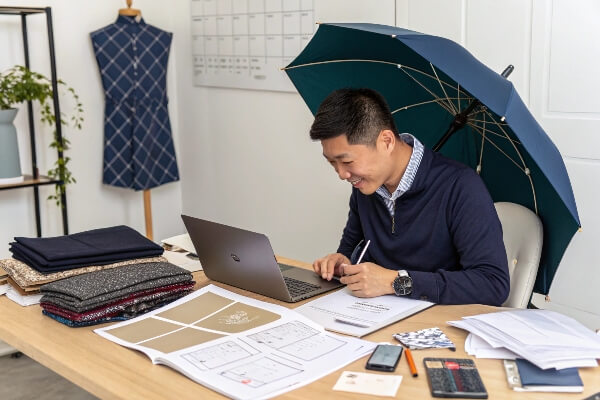
1Create Your Tech Pack (What Buyers Must Define)
Don’t start with “How much is an umbrella?” Start with specs.
A good Tech Pack lets a factory quote accurately and produce consistently.
Tech Pack Checklist (12 Must-Haves) Copy & Paste
- Model / Use Case: compact, golf, stick, reverse, kids
- Size: arc size (e.g., 21″ / 23″ / 62″) and open diameter
- Canopy Panels: 6/8/10 panels
- Fabric: 190T polyester / 210T pongee / rPET / 300T premium
- Coating: none / black UV / silver UV / water-repellent finish
- Frame: steel / aluminum / fiberglass / full fiberglass ribs
- Functions: manual / auto open / auto open-close
- Handle: ABS / rubber / wood / bamboo + logo method
- Printing: screen / digital sublimation / heat transfer + placement
- Color Standard: Pantone codes + tolerance expectations
- Packaging: polybag / sleeve / hangtag / gift box
- Compliance (if needed): REACH / Prop 65 / CPSIA / etc.
Tip: If you don’t have a Tech Pack, a reference sample + photos is enough for us to build a spec sheet.
2Verify the Supplier Is a Real Manufacturer (Not a Middleman)
Many “suppliers” are trading companies. That’s not always bad, but it often adds margin and slows technical communication.
Your goal is to confirm who actually controls printing, cutting, sewing, and QC.
Factory Verification Checklist
- Live video tour: cutting table, printing line, sewing line, assembly, packing
- Raw material stock: fabric rolls, ribs, shafts, handles (not just a sample shelf)
- QC tools: inspection tables, function tests, key process checkpoints
- Technical Q&A: ask about printing (screen vs sublimation) and color control
- Response speed: factories explain “how”; middlemen often say “I’ll check”
3Sampling & Prototyping (Never Skip This)
Sampling validates print color, alignment, fabric feel, and frame performance.
Sample cost depends on complexity: print method, trims, custom handle, or mold needs.
“For many projects, sampling is a quality deposit. On confirmed bulk orders, we often credit part of the sample cost depending on the order structure.”
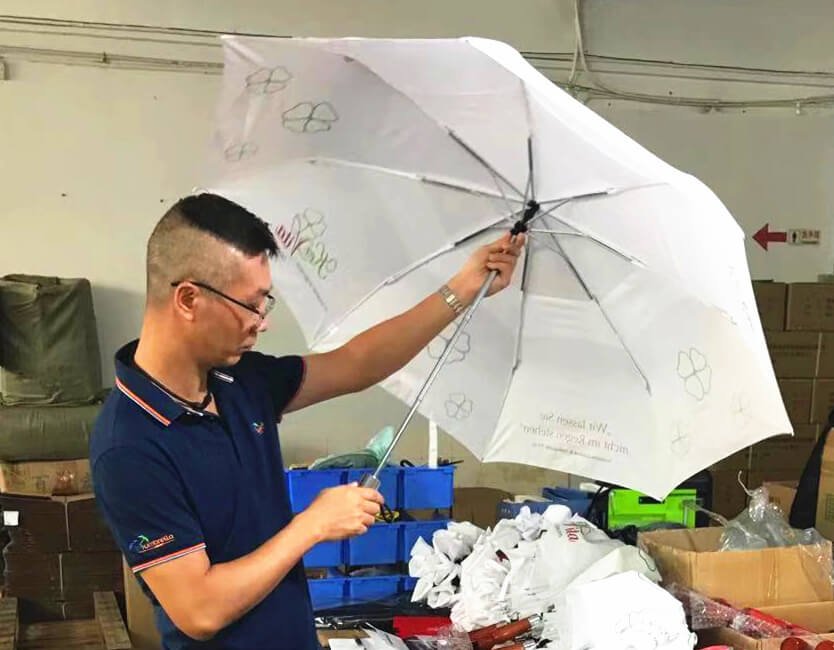
Phase 2: Production & Quality Control (QC)
Step 4–6: Prevent disputes by defining standards
4Payment Terms & Production Agreement
The most common terms are 30% deposit to start production and 70% balance before shipment.
Repeat buyers may negotiate more flexible terms (case-by-case).
Make Sure the Agreement Includes
- Approved sample reference: the sample becomes the “golden standard”
- AQL level: Major/Minor defect threshold + critical defect = zero tolerance
- Allowed tolerances: size, weight, print placement shift, color variation expectations
- Rework / replacement rules: what happens if QC fails
5Mass Production (What Actually Happens)
Typical flow: material procurement → cutting → printing → sewing → frame assembly → finishing → packing.
Production lead time is usually 25–40 days, depending on material availability and customization.
Busy seasons and holiday windows can extend lead times—plan early if you have a fixed event date.
6Quality Control: AQL Standards (How to Define “Good”)
“Quality” must be measurable. Most B2B buyers use AQL-based inspection with defect grading (Critical / Major / Minor).
A common approach is AQL 2.5 for Major and AQL 4.0 for Minor, tightened for premium programs.
| QC Area | What We Check | Common Failure to Prevent |
|---|---|---|
| Function | Open/close smoothness, rebound safety, locking, tips alignment | Stuck runners, unstable locking, safety rebound issues |
| Color consistency, panel alignment, edge clarity, rub resistance | Misalignment across seams, blurred edges, fading/rubbing | |
| Workmanship | Loose threads, glue marks, crooked stitching, wrinkles | Bad finishing that triggers returns and poor reviews |
| Materials | Fabric defects, rib integrity, handle fit, coating uniformity | Ribs snapping, handles loosening, patchy coating |
“If your umbrella carries your brand name, don’t rely on ‘factory self-check’ only. Use AQL + pre-shipment inspection and treat the approved sample as the QC baseline.”
Phase 3: Logistics (FOB vs DDP)
Step 7–8: Choose the shipping model that matches your risk tolerance
7Pre-Shipment Inspection & Final Approval
Before shipping, confirm cartons, quantities, labels, and receive photos/videos of finished goods.
If you use a third-party inspector, schedule early to avoid missing vessel cut-offs.
8Shipping: FOB vs DDP (Choose Your Responsibility Level)
Here’s the simplest breakdown:
| Term | Who Handles What | Best For |
|---|---|---|
| FOB | Factory delivers to port + export; buyer handles freight, customs, duty/VAT, local delivery | Buyers with a forwarder and customs experience |
| DDP | Factory/forwarder handles freight + customs + duties/taxes; delivered to your door | Buyers who want predictable landed cost and minimal paperwork |
Want a predictable landed cost? DDP is usually the cleanest option.
Prefer controlling freight rates and customs yourself? FOB can be more flexible.
Ready to Source with Confidence?
Send your target model, quantity, destination, and artwork.
We’ll recommend the best spec, QC standard, and shipping plan (FOB or DDP).
Get a Tech Pack Template + Quote
Pro move: start with a physical sample first. It saves time and money.
FAQ (China Umbrella Sourcing)
What is the minimum order quantity (MOQ) for custom umbrellas?
MOQ depends on customization. Digital printing projects often start from around 50 pcs per design. Custom-dyed fabric colors or special components usually require higher MOQs. Share your model, design, and quantity for a precise recommendation.
What should I include in a Tech Pack to get an accurate quote?
At minimum: model/use case, size (arc), fabric type, frame material, printing method + placement, Pantone colors (if needed), packaging, target quantity, and destination (for shipping). Use the checklist above as your template.
How long does it take from idea to delivery?
Typical timing: sampling 7–12 days, production 25–40 days, shipping air 5–10 days or ocean 35–60 days. Total lead time often lands between 6–16 weeks depending on season and destination.
What AQL standard should I use for umbrella quality inspection?
Common setups are AQL 2.5 (Major) and AQL 4.0 (Minor) with Critical defects set to zero tolerance. Premium programs often tighten this. Your agreement should define defect grading and use the approved sample as the QC baseline.
What are the most common quality issues in custom umbrellas?
Most frequent issues: print misalignment across panels, rubbing/fading from poor printing, weak frames (wind), loose stitching/threads, and inconsistent components. Sampling + AQL inspection prevents most headaches.
How do I avoid color mismatch (Pantone vs real product)?
Provide Pantone codes, confirm fabric/coating, and approve a physical swatch or sample under standard lighting. Material and coatings affect output, so sampling is the practical way to lock brand-critical colors.
Should I choose FOB or DDP?
Choose DDP if you want predictable landed cost and minimal paperwork. Choose FOB if you have a forwarder and want to control customs and local delivery. First-time buyers often pick DDP to reduce risk.
What payment terms are normal when sourcing from China?
Most common terms are 30% deposit and 70% balance before shipment. Repeat buyers and long-term programs may negotiate different terms based on stability and risk profile.
Do I need third-party inspection?
For new suppliers or strict brand requirements, third-party inspection is recommended. It reduces disputes and protects you before goods leave the factory.